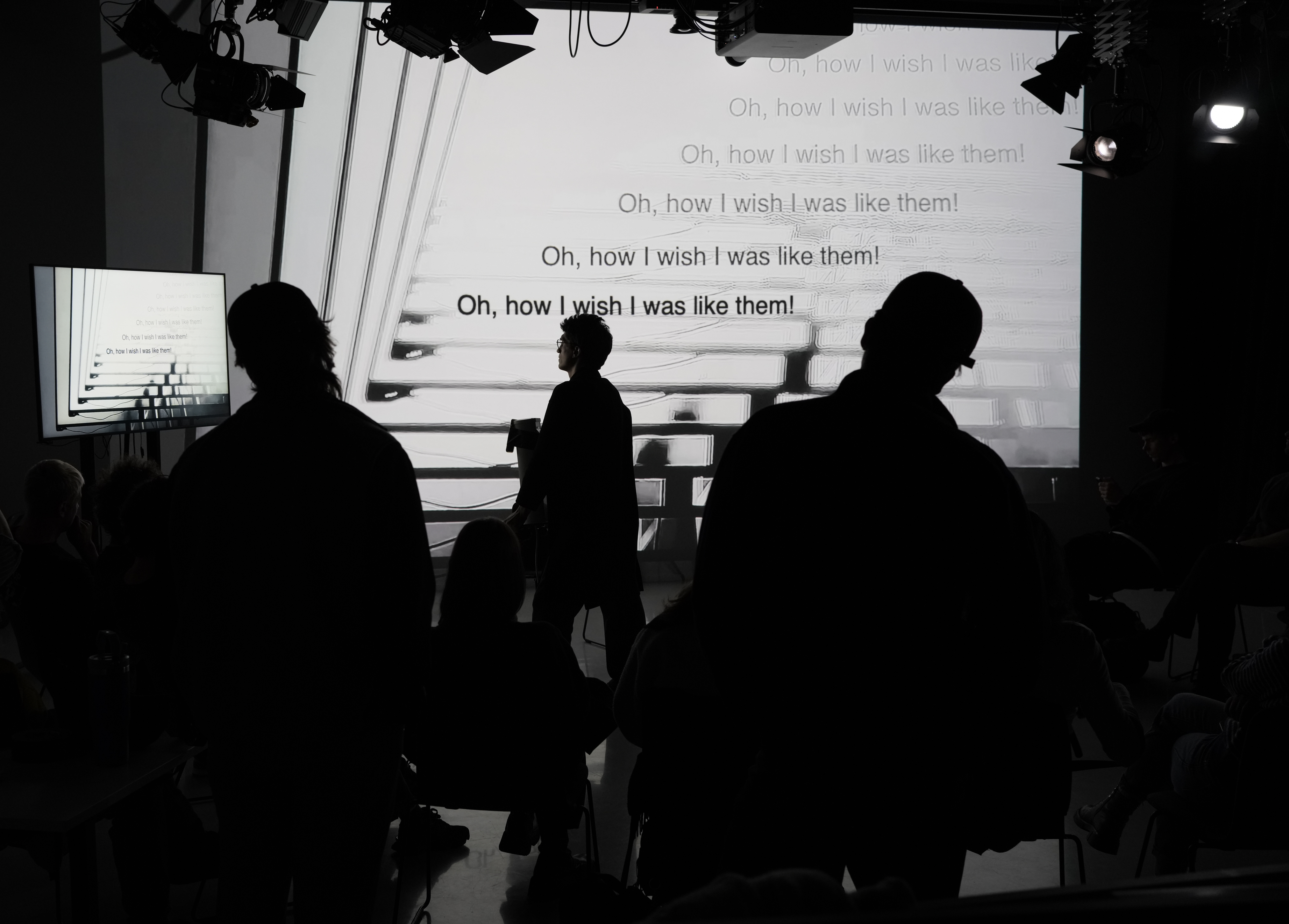
Within EXPAND, creative director Tudor Romulus Licu and creative technologist Felix Pages are exploring how new technologies can become dramaturgical tools rather than simply being added on top of a theatrical performance.
Our journey began in Avignon, as part of SVSN, where we encountered the work and practices of new media artists including Claudix Vanesix and Tung-Yen Chou. During the first EXPAND lab in Finland, we developed and presented a first fragment of Rhinoceros, a project loosely inspired by the final monologue of Eugène Ionesco’s play.
Starting from the recent phenomenon of “reverse Turing tests” (AI systems attempting to determine whether a text was written by a human or another AI) we decided to reverse the question once again and test the audience instead. We created a character representing an advanced robot, paradoxically built from analogue materials, whose body also functions as a live-cinema camera. The first version was presented in Espoo in front of Marie Point (Dark Euphoria), Jussi Sorjanen (Espoo Theatre), Yves Degryse (NTGent) and Stijn Jansen (Wintercircus).
For the next stages of EXPAND in Cannes and Craiova, we want to push this device further. We imagine the robot becoming capable of recognising, in real time, the objects and people it sees. At one point, it looks at itself in a mirror, but fails recognises what is there. Something begins to glitch. From that moment on, its descriptions slowly stop being objective: objects acquire associations, images and metaphors.
What interests us is this passage from recognition to imagination. Can a machine stop describing the world and begin, somehow, to write it? By bringing live cinema, object recognition and AI into the dramaturgical structure itself, we want to explore the possibility of creating a form of digital poetry that could question the very technologies through which it is expressed.
“Oh, how I wish to be like them!” (Berenger talking about Rhinoceros in E. Ionesco’s play / our “E.I.” machine talking about humans in our staging and adaptation of it)