Censored under Ceaușescu, Matei Vișniec left Romania in 1987, lived and worked for a period in London, and eventually settled in France, where he began writing theatre directly in French. His work regarding what I like to call “secret languages” began out of necessity. Under the brutal censorship of the Ceaușescu regime, a young Matéi was writing subversive poetry, criticising the regime through ambiguous metaphors that every reader understood perfectly, while still giving him some plausible deniability. When I first met him, he read to me one of his first poems, one about “a horse” that got him a prize in high-school and allowed him to visit Bucharest for the first time. He also recounted his first encounter with the “Securitate”, the Romanian Secret Police that paid him a visit suspecting that this horse was in reality a symbol for the dictator, which could’ve ended his career as a poet, if not his life, quite early. When asked about this, a young Matei got extremely offended and demanded to speak to the superior of the Securitate officer, accusing him of betraying the party by comparing our comrade with such a vile animal. I was shocked to hear this and so I asked him what the horse was a symbol for in reality – “For Ceaușescu, of course!”, Visniec replied, “But not even they had the right to say what was clear for everyone.”
the horse passed by one of the streets
of the universe me by another
we never really meet
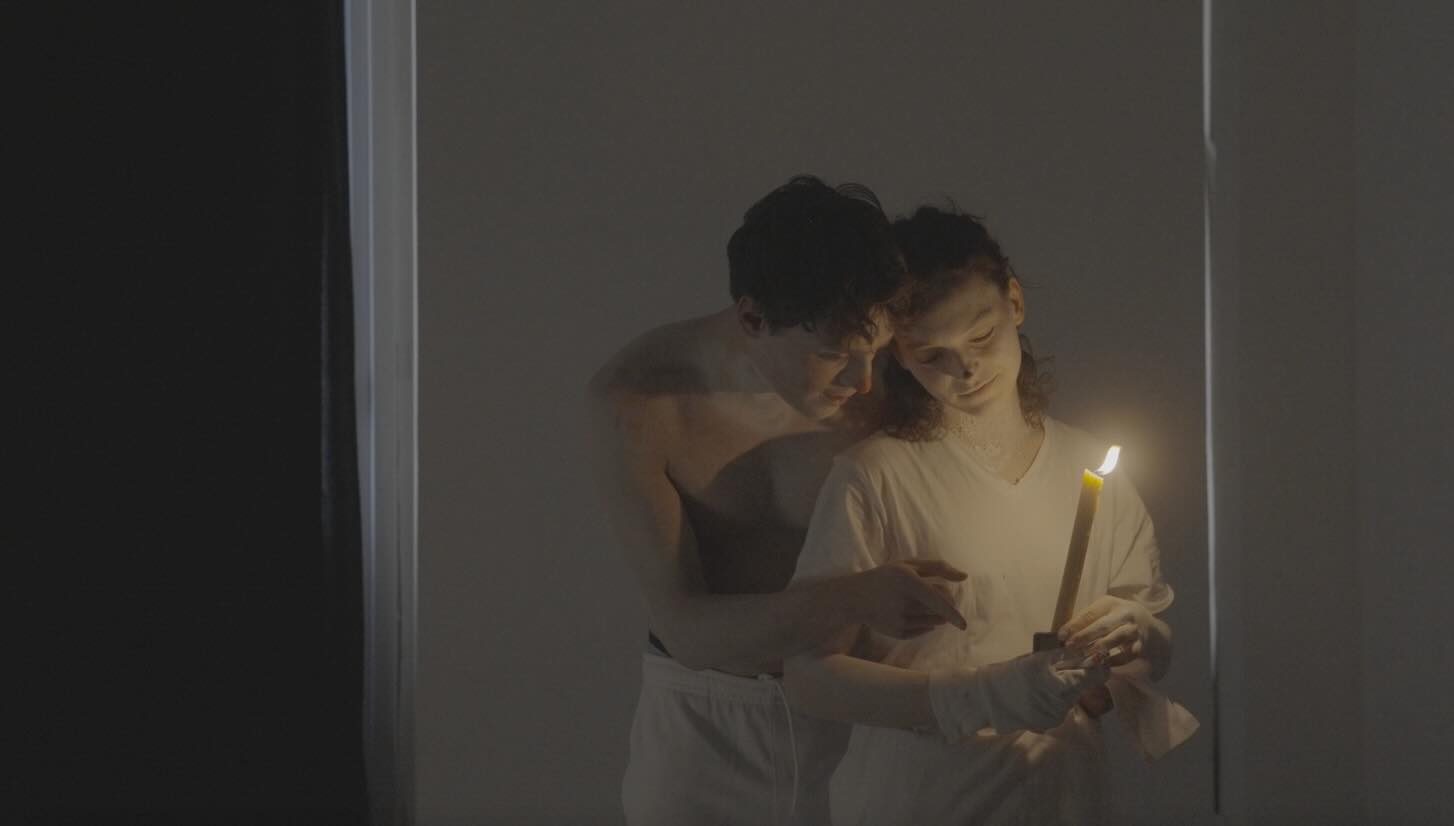
In The Story of Panda Bears Told by a Saxophonist Who Has a Girlfriend in Frankfurt, two strangers wake up together after a night neither of them can fully remember. Weirdly magnetised to one another, they decide to spend nine nights together. From there, the play follows the strange intimacy that begins to grow between them, somewhere between love, play, misunderstanding and the fear that whatever they are building might disappear.
Performed by French actress Juliette Castro and Turkish actor Ömer Faruk, the production looks at Vișniec’s text through the encounter of two people who don’t necessarily come from the same place, speak the same language or share the same cultural codes. In this sense, Vișniec’s own relationship to language and displacement becomes particularly important. His poetics of language are not only an aesthetic choice, but a means to an end. Little by little, through words, gestures, games, misunderstandings and rituals, the two characters find ways of overcoming the barriers between them. They invent their own “secret language” and, in a way, their own culture one that belongs only to the two of them.
The performance is built around the actors, with minimal scenography, and moves between intimacy, humour and a certain clownesque naïveté. At its core, it is a story about how even if the real world is filled with barriers and judgement for those who try to surpass them, we can all create our own little worlds in which we can make our own secret, intimate “rules”.
above the word city
floats the word fog
the word man
looks
through the
word
window